
MANAGING SCREEN TIME OF CHILDREN – DO’S AND DON’TS
October 6, 2020 2020-10-06 0:00MANAGING SCREEN TIME OF CHILDREN – DO’S AND DON’TS
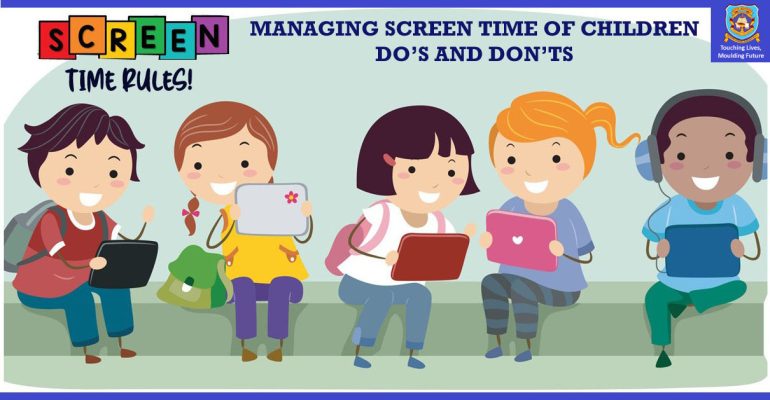
Screen time is the amount of time spent using a device with a screen. It can be anything from phones, tablets, computers, video games, televisions, etc. The general idea behind the effects of screen time come from how technology has taken over most mediums of learning, and the idea of placing the boundary between how much of it is okay and how much is not. The positive or negative health effects of screen time are influenced by levels and content of exposure.
Increased use of screens among children has led to an increase in sedentary activity because most screen usage occurs while sitting. An excess amount of screen time can increase the risk of:
Inconsistent sleep: The more screen time a child has, the more likely he will be to have trouble falling asleep or maintaining a regular sleep schedule.
Obesity: Children who spend excessive amounts of time in front of a screen are less likely to be active. Also, exposure to commercials of junk food, etc lead to cravings among children for food that is high in fat and sugar.
Behaviour and attention problems: Excessive media use can lead to difficulties in school, attention problems, hyperactivity and behavioural issues.
Social isolation: The rise in social media and communication online affects children’s ability to communicate face-to-face. Although social media allows maintaining relationships more effectively with more people, but there is no question that we tend to communicate less in person as a result and thereby hampering social skills.
Building habits for later life: Developing the habit of spending a lot of time with a screen during childhood tends to be perpetuated into adulthood.
With screens virtually everywhere, controlling a child’s screen time can be challenging. To complicate matters, some screen time can be educational for children as well as support their social development. As technology advances, so does learning and both often overlap in certain aspects, however, it can be highly detrimental for the development of children. That being said, setting limits on screen time for children isn’t always easy in today’s screen filled world.
Children learn from the examples that their parents set. Hence, the first step to managing screen time is that parents should limit their own share of screen time.
The next thing to do is to help children find activities they like. It could be swimming, running, skipping, cycling, or any other activity. If parents help them discover what they like, they will enjoy being physically active. By physical activity, it could mean anything that can get them off the couch and get active. There’s a time for screens, but not at the expense of time for getting active and outdoors and connecting with people in real time.
Here are some do’s and don’ts that can be helpful in effectively managing screen time of children:
Do set time limits and stick to them: Whether it is 1 hour of TV after homework is done or no more than 30 minutes total of texting with friends, establish clear rules and limits for screen time. And be as firm and consistent as possible, no matter how tempting it is to give in to the child’s request.
Do get screens out of the child’s room: Monitoring a child’s screen use would be difficult if they are able to use devices without supervision. It is linked with lower test scores as well as interference with sleep patterns.
Do create a “screen free” zone in the house: Designate a room or two in the house that is free of a TV, computer, and electronic devices. Similarly, “screen free” times can be mandated at appropriate hours like during dinner or before bedtime.
Do teach appropriate screen time behaviour: With older kids, it is not enough to model appropriate behaviour; they also need to be taught. With the explosion of social media use, children need to be aware of the dangers of these platforms, as well as how to behave while using them. They need to be careful not to share any personal information, no matter how trivial.
Do encourage a child to use screens to follow their passions and interests: Instead of simply playing video games and watching movies, children need to be challenged to use the bulk of their screen time to follow their passions and interest. If a child loves animals, they can be encouraged to use their screen time to learn more about them. By leveraging the ability of technology to educate, the child’s intellectual curiosity and passions are fed.
Don’t engage with a device during family time: Avoid engaging with a device and try to keep it away purposefully while the child is engaging with you. It gives a message to the child that the device does not compete for their attention and that people are more important than phones. They shall reciprocate this behaviour when they grow older.
Don’t use screens as an “emotional pacifier”- Young children need to learn how to deal with frustration, failure and conflict. Unfortunately these three things are incredibly hard to deal with for parents. While understandable, putting the child in front of a screen to soothe them should be avoided as it deprives them of learning important socio-emotional skills.
Don’t panic- It can be hard as a parent to navigate the rapidly shifting social world of children. The new generation uses digital spaces for socialization in different ways than we do, and understanding that difference is vital to setting reasonable limits. If a child is using screens for socialization, it is important for their development to let them have the time and space to do so. That’s not to say that they need unfettered access.
- BY SHRABANIKA MEDHI - COUNSELLOR