ARTIFICIAL INTELLIGENCE: CAREER OPPORTUNITIES FOR STUDENTS
October 5, 2024 2024-10-05 3:55ARTIFICIAL INTELLIGENCE: CAREER OPPORTUNITIES FOR STUDENTS
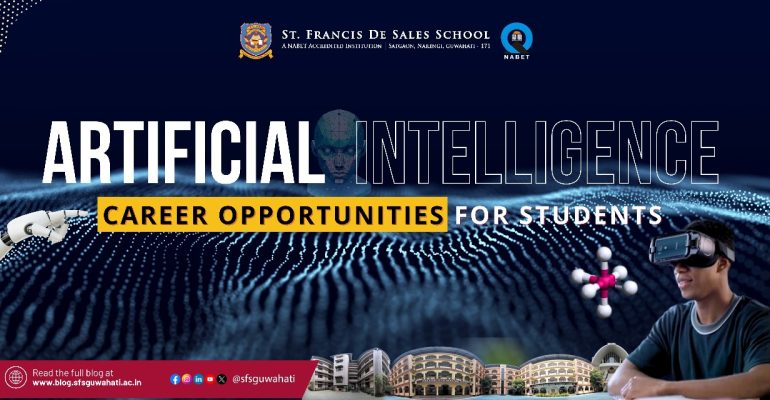
This is no longer science fiction but the future. It has become a part of our daily lives, reshaping industries and revolutionizing technologies, including exciting career opportunities for students. ARTIFICIAL INTELLIGENCE is yet on a high level on the technological advancement scale, which opens a wide range of opportunities that students can explore, mimicking human intelligence and automating complex processes.
We shall discuss in this blog the domain of AI, its importance and the career scopes for students who want to start a career in this dynamically developing domain.
Why ARTIFICIAL INTELLIGENCE is Important?
True, artificial intelligence has laid the foundation for many technologies used today. People can utilize Siri and Alexa as their personal assistants and various OTT platforms like Netflix and Amazon for recommendation systems. AI is powering everything from self-driving cars to medical diagnoses. It is transforming healthcare, finance, education, and entertainment, respectively. Expectedly, by 2030, contributions from AI will inject more than Rs. 15 trillion into the world economy, while creating millions of jobs.
In light of the rapid upsurge of demand for AI-related skills in the job market, students who develop the skills needed for AI will likely conclude that they will be making a very good career choice. Knowledge about AI-related concepts, tools, and applications can open up lucrative, intellectually stimulating, and challenging career paths.
Career Paths in ARTIFICIAL INTELLIGENCE
AI offers a range of career paths for students interested in the field, depending on their skills and interests. Some of the most exciting career paths include
1. AI Engineer
AI engineers are responsible for creating, developing, and implementing AI models and algorithms. In collaboration with data scientists, they ensure that AI solutions are capable of analyzing and processing vast volumes of data. AI engineers typically require strong programming skills, a deep understanding of machine learning algorithms, and experience in AI frameworks such as TensorFlow and PyTorch. This is one of the most in-demand and high-paying jobs within the domain of AI.
2. Data Scientist
Data scientists leverage AI to pull meaning from massive datasets. They use machine learning models to predict what will happen and help organizations make a data-driven decision. Students interested in data science should build skills around statistics, mathematics, and programming languages like Python and R. As businesses become increasingly dependent on data for making decisions, there will be the greatest need for experienced data scientists.
3. Machine Learning Engineer
Machine learning engineers design algorithms that teach machines to learn from the data. They work on systems that can learn from data and update themselves without having humans intervene. This job is great for people who want to code, solve problems, and have something to do with statistics. Machine learning engineers work in robotics, cybersecurity, and departments of autonomous systems.
4. AI Research Scientist
AI research scientists are currently working on pushing AI boundaries through new algorithms, models, and technologies. They interact with advanced AI research which can eventually bring breakthroughs in areas such as natural language processing, neural networks, and computer vision. Students interested in this career must have a very strong background in mathematics, computer science, and research methodologies.
5.Robotics Engineer
AI is quite critical in robotics, bringing robots to a point where they can complete complicated tasks solely on their own. Robotics engineers are engaged in designing and developing robots that can work with people, for surgeries, at hazardous environments, or even in space. This career encompasses a combination of AI, mechanical engineering, and computer science expertise.
6. AI Consultant
AI consultants help organizations implement AI into their operations. They assess the needs of an organization, suggest the appropriate AI technology, and oversee its implementation. This career demands a combination of technical know-how in AI and the ability to communicate as well as project manage effectively.
Key Skills in a Career in AI
Students interested in a career in AI should aim to acquire these key skills:
- Programming : AI utilizes such core programming languages as Python, R, Java, and C++.
- Mathematics and Statistics : Algebra, calculus, probability, and statistics form the basis of understanding AI algorithms and models.
- Machine Learning: The principle of machine learning along with its techniques is central to most AI positions.
- Data Management: Large datasets require the capacity to manage and process these datasets to create the AI solutions.
- Problems-Solving Ability: AI requires a flair for innovative solutions in dealing with complex challenges.
- Collaboration and Communication: For most AI projects, collaboration and being able to clearly communicate technical concepts are necessary.
At SFS GUWAHATI, we are committed to preparing students for the future by integrating AI as robotics with our CCA Club, STEM programs, and Atal Tinkering Lab (ATL) classes, ensuring they receive hands-on experience with cutting-edge technology and innovation. This field of artificial intelligence had a lot to offer for students in terms of career paths. On the one hand, one could find technical roles - like AI engineers and data scientists - and on the other hand, research-oriented positions, such as AI research scientists. Further into the future, as AI evolves more and more experts will be required, so will this sector hold a very good source of employment for students.
Building the correct skills, remaining updated with the trends set by AI, and completing internships or developing projects might put the students in the forefront of the AI revolution, thereby offering a fulfilling career in one of the most exciting fields of the future.
https://youtu.be/3sYRDQ4oKg4?si=hWHjs1rEGNdfdRC6