
Teaching the Mind to Thrive: Subconscious Reprogramming for the Next Generation
January 18, 2025 2026-06-02 9:59Teaching the Mind to Thrive: Subconscious Reprogramming for the Next Generation
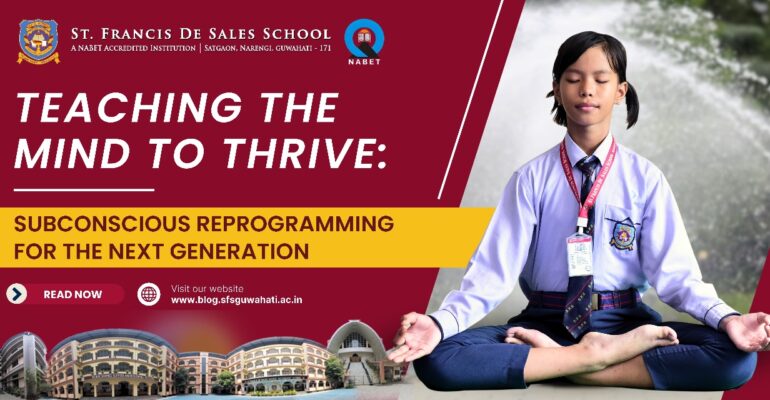
"The mind is everything. What you think, you become." — Buddha
In today's high-pressure, technology-driven society, educational institutions have a primary focus on academics and career preparation. But one crucial area that remains relatively unaddressed is that of the mental health and emotional development of children. While artificial intelligence and robotics revolutionize our world, the real potential lies in the untapped strength of children's minds. And unlocking that requires the nurturing and shaping of the subconscious mind.
We have observed how thoughts and emotions affect children in their thought patterns, behaviours, and attitudes at our institution. Motivated by this knowledge, we incorporated subconscious mind training in our curriculum that significantly improved students' emotional well-being and overall growth. We believe that every school should learn this approach to enable them to help children become emotionally resilient and mentally healthy.
Understanding the Subconscious Mind
The subconscious mind controls the majority of our thoughts, emotions, and actions—that is, 95% of our daily behaviors. In the early years of development, children between the ages of 0-7 are like sponges, soaking up everything around them, forming beliefs that will guide their later choices and actions. This period, often referred to as the "programming years," is essential in helping shape a child's mental framework.
Unfortunately, mental health issues among children are on the rise. According to a 2023 UNICEF report, 13% of adolescents worldwide suffer from mental health disorders, with anxiety and depression being the most common. Schools can take a critical role in emotional well-being and give children lifelong coping mechanisms by working on subconscious patterns early.
Our Journey Toward Holistic Education
When we started this journey, the key objective was to provide quality education through practical, experiential, and engaging methodologies. However, we gradually realized that actual education is beyond the mere act of academic accomplishment. It includes training children in emotions and self-management. In doing so, we introduced a program for structured subconscious mind training beginning with mindful practices in our daily assemblies.
One such inspiring story is of a Grade 3 student, who had gone through acute test anxiety post COVID-19 pandemic. She would know her things but would just freeze in front of an examination paper and become unable to write. She would not show improvement even with regular counseling. In two months after subconscious mind practice, she got the confidence to score well in exams. The success stories of thousands of students demonstrate how these practices can transform the lives of these young minds.
Core Subliminal Reprogramming Practices
Our subconscious mind training is holistic, and we have the following mindful practices included:
1. Meditation
Meditation helps calm the mind, reduce stress, and improve focus. Studies by the American Psychological Association (APA) show that regular meditation enhances emotional regulation and reduces anxiety in children. We incorporate different types of meditation: breathing exercise, guided visualization, and chakra healing.
Even our youngest students participate in guided meditation sessions, connecting with their inner selves. This practice has significantly improved their confidence and emotional resilience, proving that mindfulness can positively shape young minds.
2. Visualization
Visualization involves imagining positive outcomes to create neural pathways for success. After meditation, students engage in guided visualizations, picturing themselves achieving their goals, such as confidently delivering a speech or calmly completing an exam.
Research shows that the brain responds to vividly imagined experiences similarly to real ones. This mental rehearsal helps children build self-belief and prepare for success, fostering a positive mindset.
3. Affirmations
Positive affirmations empower the child to redo limiting beliefs and build confidence. Our students learn to do morning affirmations every day starting with "I am," which could be "I am confident," "I am capable," and "I am calm." Neuroscientists do support using affirmations as a way to create neural connection strengths and support the development of good thought patterns.
Through persistent practice, our students have learned to take responsibility for their emotions and thoughts, hence improving their outlook on life and their ability to face challenges.
4. Gratitude
Gratitude shifts focus from what is lacking to appreciating life's blessings. Our students practice gratitude daily by writing or speaking sentences like, "Thank you for my pencil" or "Thank you for the fresh air I breathe."
This simple habit breeds contentment and patience, hence emotional well-being. Studies by UC Berkeley's Greater Good Science Center have indicated that gratitude boosts mental health, making it a great practice for children.
5. Forgiveness
Forgiveness helps free the mind from negative emotions and breeds emotional growth. This practice has bred a culture of empathy and self-compassion, allowing students to let go of grudges and embrace positivity.
Transforming Lives: The Ripple Effect
These practices have had a profound impact. Parents have noticed their children are calmer, more focused, and more confident. Students who used to shy away from speaking in public now volunteer for performances, and those who were struggling with academic tasks have developed confidence.
However, this mission is not only in schools. Because children spend much time at home, the role of parents becomes significant. The parents who implement these practices will have a supportive and consistent environment for their child, thus furthering their child's emotional development.
A Future Vision
Subconscious mind reprogramming has its benefits that reach far beyond academics. It helps children be mentally healthy and emotionally resilient as they face the challenges of life with a positive attitude. Imagine a world where every child grows up to achieve their dreams. This becomes a reality when schools and families work together toward emotional and mental health.
As educators, parents, and caregivers, we share the responsibility of nurturing the next generation of self-aware, emotionally resilient individuals. Let us embrace mindful practices and unlock the boundless potential within our children's minds.